
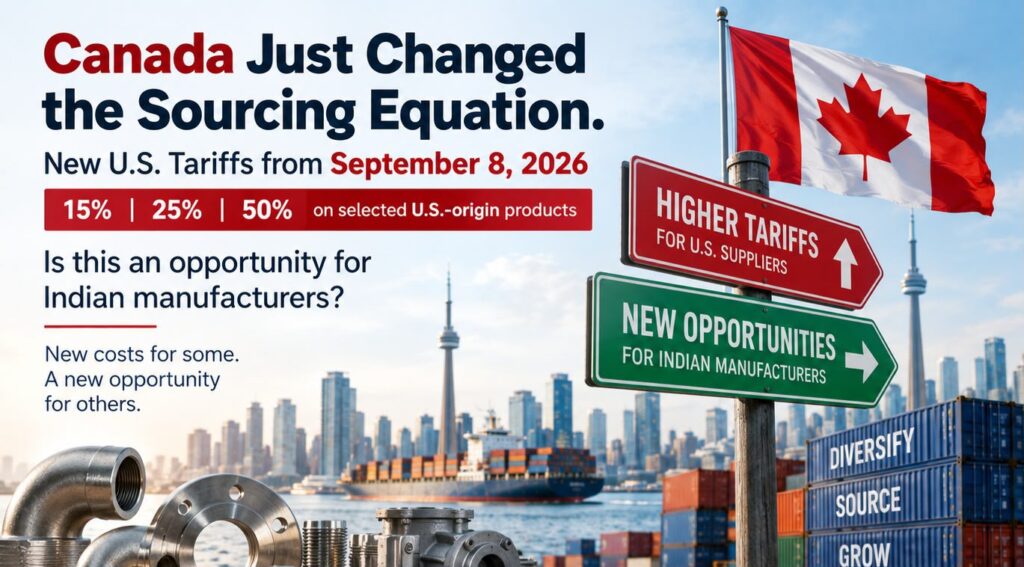
Canada’s new counter-tariffs on selected U.S.-origin products have changed the sourcing equation for some Canadian importers. Effective September 8, 2026, Canada introduced counter-tariffs of 15%, 25% and 50% on selected U.S.-origin goods, covering approximately C$27.6 billion of imports from the United States. For Indian manufacturers, the important question is not simply:
“What tariffs has Canada imposed on U.S. products?”
The more commercially useful question is:
Which Canadian buyers are affected by these tariffs, and could sourcing from India now provide a competitive alternative?
For manufacturers of steel and stainless-steel fittings, fasteners, aluminium fittings and pump parts, this is particularly worth investigating.
However, there is an important distinction.
A 50% Canadian counter-tariff on a U.S.-origin product does not automatically make an equivalent Indian product 50% cheaper.
The opportunity can only be established after comparing the exact HS code, origin, applicable Canadian duty, freight, compliance requirements and total landed cost.
That is where market intelligence becomes important.
Why Canada’s Tariff Changes Matter to Indian Exporters
International sourcing decisions are rarely changed by a news headline alone.
Buyers change suppliers when their existing sourcing model faces a commercial or operational problem.
That problem could be:
- Higher landed cost
- Supply disruption
- Excessive lead times
- Capacity constraints
- Quality problems
- Geographic concentration
- Regulatory changes
- Tariffs
Canada’s new counter-tariffs create one such change.
A Canadian company that has sourced the same component from a U.S. supplier for years may suddenly need to reconsider the economics of that relationship.
The buyer may not immediately replace the U.S. supplier.
But procurement teams could begin asking:
Can we find an alternative source?
Would India be commercially competitive?
Should we qualify a second supplier?
Can we reduce our exposure to one sourcing country?
That creates an opening for capable Indian manufacturers.
Which Engineering Products Should Indian Manufacturers Watch?
Several products on Canada’s tariff list overlap with areas where India has established engineering manufacturing capabilities.
Here are four categories worth examining.
1. Steel and Stainless-Steel Pipe Fittings
Canada’s tariff measures cover several products under HS heading 7307, which covers tube or pipe fittings of iron or steel.
Selected tariff items include categories such as:
- Stainless-steel flanges
- Threaded elbows
- Bends and sleeves
- Butt-welding fittings
- Other iron and steel flanges
- Other tube and pipe fittings
Selected U.S.-origin goods within these categories face a 50% counter-tariff.
For Indian manufacturers producing steel and stainless-steel fittings, this creates a reason to investigate Canadian buyers that currently rely on U.S. suppliers.
But the strategy should not begin with sending hundreds of emails.
It should begin with import data.
2. Fasteners
Fasteners represent another interesting category.
Canada’s tariff list includes numerous products under HS heading 7318, covering iron and steel fasteners such as:
- Screws
- Bolts
- Nuts
- Washers
- Rivets
- Cotters and cotter pins
Selected listed products face a 50% counter-tariff when they qualify as U.S.-origin goods covered by the measures.
India has a broad manufacturing base for standard and custom fasteners.
But Canadian buyers will not change suppliers simply because India can manufacture the product.
An Indian supplier still needs to compete on:
Quality + specification + certification + delivery + capacity + landed cost + reliability
3. Aluminium Tube and Pipe Fittings
HS 7609.00.00, covering aluminium tube or pipe fittings such as couplings, elbows and sleeves, is included in Canada’s measures at 50% for qualifying U.S.-origin goods.
This could be relevant for Indian companies manufacturing:
- Aluminium fittings
- CNC-machined aluminium components
- Extrusion-based components
- Precision industrial parts
- Custom aluminium components
Again, product classification needs to be verified before approaching buyers with any tariff-related proposition
4. Pump Parts
Another relevant category is:
HS 8413.91.00 — Parts of pumps
This tariff item is included at 25% for qualifying U.S.-origin goods.
That makes the development worth studying for Indian manufacturers supplying pump components and related engineering parts.
Potential Canadian targets may include:
- Pump manufacturers
- Industrial distributors
- OEMs
- Maintenance suppliers
- Process-industry companies
- Equipment manufacturers
The real opportunity is to identify which of these companies currently depend on affected U.S.-origin products.
A 50% Tariff Does Not Mean India Is 50% Cheaper
This is perhaps the most important point for exporters.
Suppose Canada imposes a 50% counter-tariff on a particular U.S.-origin product.
It would be incorrect to approach Canadian buyers saying:
“Buy from India and save 50%.”
The Indian product has its own Canadian tariff treatment and import requirements.
Therefore, the real calculation should compare the buyer’s total landed cost.
Existing U.S. sourcing
Product price + freight + applicable duties/charges + counter-tariff + other import costs
Potential Indian sourcing
Product price + freight + applicable Canadian duty + compliance costs + other import costs
Even if the Indian route appears cheaper, procurement teams will also evaluate:
- Lead time
- MOQ
- Quality
- Certifications
- Inventory requirements
- Payment terms
- Packaging
- Supplier reliability
- Switching costs
This is why exporters should avoid quoting a percentage saving until the exact product and HS classification have been verified.
The Better Export Strategy: Start With the Buyer’s Problem
Many exporters approach international markets in the same way.
They select a country.
Then search for companies.
Then collect hundreds or thousands of email addresses.
Finally, they send a generic introduction:
“We are a leading manufacturer from India…”
Canada’s tariff situation creates an opportunity to take a more intelligent approach.
Instead of starting with a database, start with the commercial change.
The process should look like this:
Tariff Change → HS Code → Product → U.S. Supplier → Canadian Buyer → Landed Cost → Indian Supplier → Outreach
Let’s break that down.
Step 1: Identify the Exact HS Code
Start with the Indian manufacturer’s actual product range.
Determine the appropriate Canadian tariff classification.
Then verify whether the competing U.S.-origin product is included in Canada’s counter-tariff measures.
Do not rely only on a broad description such as:
“Fasteners face 50% tariffs.”
Individual tariff classifications matter.
Step 2: Identify Canadian Buyers Sourcing From the United States
This is where the research becomes commercially valuable.
Instead of searching:
“Fastener importers in Canada”
ask:
“Which Canadian companies import my specific fastener category from U.S. suppliers?”
For fittings:
“Which Canadian distributors currently source these fittings from the United States?”
For pump parts:
“Which Canadian OEMs or distributors import affected pump components from U.S. suppliers?”
This dramatically improves buyer targeting.
Step 3: Compare U.S. and Indian Landed Costs
Once a relevant Canadian buyer is identified, calculate the economics.
Compare:
USA → Canada
with
India → Canada
using the exact product classification.
The calculation should consider:
- Supplier price
- Import duty
- Counter-tariff where applicable
- Ocean/road/air freight
- Insurance
- Customs and brokerage
- Packaging
- Compliance
- Inventory implications
- Lead time
Only then can an exporter determine whether India has a meaningful advantage.
Step 4: Verify the Indian Manufacturer’s Capability
Lower landed cost alone does not make a good supplier.
Before positioning an Indian manufacturer as an alternative, verify whether the factory can meet the Canadian buyer’s requirements.
This may include:
Manufacturing capability
Does the supplier actually manufacture the product in-house?
Technical capability
Can it manufacture from drawings and meet the required tolerances and material specifications?
Quality control
Are incoming, in-process and final inspections properly managed?
Certifications
Can the supplier provide the certifications required by the buyer or product?
Documentation
Are test reports, material certificates and traceability records available?
Capacity
Can the manufacturer support the buyer’s current and future volumes?
Delivery
Can realistic lead-time commitments be maintained?
A tariff advantage may create the conversation.
Supplier capability determines whether the conversation becomes business.
Step 5: Change the Buyer Outreach
Once the research is complete, the sales message should also change.
Avoid starting with:
“We are an Indian manufacturer and would like to introduce our products.”
Instead, the conversation can focus on the buyer’s changing sourcing economics:
“With Canada’s new tariffs on selected U.S.-origin products now in effect, we are evaluating whether alternative Indian sourcing could provide a landed-cost advantage for Canadian buyers in this product category. Would it be useful to compare the economics at the exact HS-code level?”
This creates a commercial reason for the buyer to respond.
The manufacturer is no longer simply selling a product.
They are offering the buyer a possible sourcing solution.
India Does Not Have to Replace the U.S. Supplier
There is another important opportunity that manufacturers should not overlook.
A Canadian buyer may be completely satisfied with its U.S. supplier.
The objective does not necessarily need to be:
USA → India
Instead, it could become:
USA + India
The Canadian buyer retains its existing supplier while qualifying an Indian manufacturer as a second source.
This can help procurement teams diversify:
- Tariff exposure
- Geographic concentration
- Supply disruption risk
- Capacity constraints
- Pricing risk
For an Indian manufacturer, becoming an approved second source can be the first step toward a much larger relationship.
A small trial order could eventually develop into:
Sample → Trial Order → Approved Supplier → Repeat Orders → Larger Volumes → Long-Term Partnership
What Canadian Buyers Should Evaluate When Sourcing From India
The opportunity also needs to be considered from the buyer’s perspective. A tariff may create an incentive to investigate India. But selecting an international supplier requires due diligence. Canadian importers, distributors and OEMs should evaluate:
Actual Manufacturing Capability
Is the company genuinely manufacturing the product?
Quality Systems
Can it demonstrate consistent quality across production batches?
Technical Expertise
Can the manufacturer work with drawings, tolerances and custom specifications?
Documentation and Traceability
Can required inspection reports, material certificates and other documents be provided?
Production Capacity
Can the supplier support higher volumes if the business grows?
Export Experience
Does the company understand international packaging, documentation and logistics?
Communication
Can commercial and technical questions be handled professionally and quickly?
Delivery Reliability
Can promised production and shipment schedules actually be maintained?
The objective should not be to find the cheapest alternative to America.
It should be to find a competitive and reliable additional sourcing partner.
Why This Matters Beyond Canada
There is a larger lesson here for Indian exporters.
International trade opportunities are often created when something changes:
- A tariff changes
- An FTA enters into force
- A competitor faces higher duties
- Freight routes become disrupted
- A country changes sourcing regulations
- Buyers face supply shortages
- New compliance requirements emerge
Most businesses see these developments as news.
Exporters should see them as signals.
Then investigate whether those signals change the economics for a specific product and buyer.
At V Global, we look at this through four connected elements:
POLICY → PRODUCT → BUYER → SUPPLIER
A policy changes.
Identify the affected product.
Find the buyer experiencing the impact.
Then determine whether an Indian manufacturer can provide a commercially and technically credible alternative.
That is how trade intelligence becomes a business opportunity.
How V Global Can Help Indian Manufacturers Explore the Canada Opportunity
At V Global, our approach is not to create a generic database of Canadian companies and begin mass outreach.
We focus on identifying where a genuine buyer-manufacturer fit may exist.
For Indian manufacturers evaluating this opportunity, the process can include:
- Product and HS-code mapping
- Tariff opportunity analysis
- Canadian market research
- Import-data analysis
- Competitor-country analysis
- U.S.-dependent buyer identification
- Importer and distributor research
- Buyer prioritisation
- Supplier capability matching
- Landed-cost positioning
- Targeted buyer outreach strategy
For Canadian and international buyers, V Global can also support:
- Indian manufacturer identification
- Supplier shortlisting
- Factory verification
- Manufacturing capability assessment
- Supplier due diligence
- Sourcing intelligence
The objective is not simply to find more leads.
It is to identify better commercial matches.
Canada’s September 8 tariff measures do not automatically create an opportunity for every Indian exporter. Nor do they automatically make India the lowest-cost sourcing destination.
But for selected product categories particularly steel and stainless-steel fittings, fasteners, aluminium fittings and pump parts they create a strong reason to investigate the Canadian market.
The right question is not:
“Can we export to Canada?”
It is:
“Which Canadian buyers currently source our product from the United States, and has their sourcing equation changed?”
If the answer is yes, the next step is not mass emailing. It is verifying the HS code, landed cost, buyer requirement and Indian supplier capability. Because trade disruptions do not automatically create export orders.
They change buying economics. And when buying economics change, well-prepared manufacturers have an opportunity to enter the conversation.
Frequently Asked Questions
When did Canada’s new tariffs on selected U.S.-origin goods take effect?
The counter-tariffs took effect at 12:01 a.m. on September 8, 2026.
What are the new Canadian counter-tariff rates?
Selected U.S.-origin goods are subject to counter-tariffs of 15%, 25% or 50%, depending on the tariff item.
Do Indian products face these Canadian counter-tariffs?
These particular countermeasures target qualifying U.S.-origin goods. Indian products have their own applicable Canadian tariff treatment and import requirements, which need to be checked using the exact classification.
Does a 50% U.S. tariff mean India is 50% cheaper?
No. The buyer must compare the complete landed cost of U.S. sourcing against Indian sourcing. Freight, normal customs duties, compliance costs, lead times and other costs can materially change the result.
Which Indian engineering sectors should examine the opportunity?
Based on affected Canadian tariff items, areas worth investigating include steel/stainless-steel pipe fittings, iron and steel fasteners, aluminium tube/pipe fittings and pump parts.