
And Turn Disruption into Strategic Advantage
Global trade has always faced disruption.
But the 2026 Strait of Hormuz crisis is different.
It is not just affecting shipments.
It is impacting the core of global logistics energy, routes, cost, and predictability.
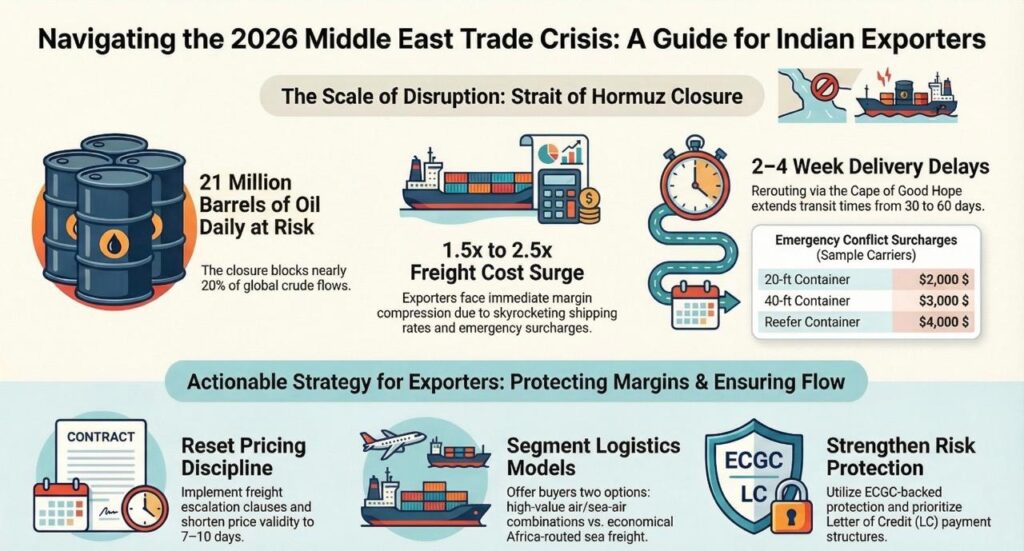
With nearly 20% of global oil flows passing through the Strait, even a partial disruption can ripple through freight rates, transit times, and supply chain planning worldwide.
For Indian exporters, this is not just another external shock.
👉 It is a real-time test of adaptability, resilience, and strategic thinking.
⚠️ What’s Really Happening (Beyond the Headlines)
Since early 2026, exporters have been facing multi-layered disruptions:
- Freight costs are rising 1.5x to 2.5x, depending on route and urgency
- War-risk insurance premiums are increasing sharply
- Transit times are extending by 2–4 weeks due to rerouting
- Container shortages and port congestion at alternate routes
- Carriers are limiting exposure to the Gulf and Red Sea routes
A shipment that once took 25–30 days is now stretching to 45–60 days.
👉 This is no longer just a logistics issue.
It is a loss of predictability across cost, time, and execution.
📦 What This Means for Indian Exporters
For exporters operating from key hubs in Western India, the impact is immediate:
1️⃣ Margin Compression
Freight is no longer a fixed cost; it’s volatile.
Hidden increases include:
- Rerouting charges
- Emergency surcharges
- Priority booking premiums
👉 Logistics has become a strategic cost driver, not a backend expense.
2️⃣ Delivery Uncertainty
Extended timelines are creating real risks:
- Missed delivery commitments
- Project delays
- Longer working capital cycles
👉 Exporters are now managing timeline risk, not just shipments.
3️⃣ Changing Buyer Expectations
Global buyers are shifting focus from price to:
- Reliability
- Transparency
- Responsiveness
- Risk-handling capability
👉 In today’s environment, how you respond matters more than what you quote.
4️⃣ Contract Exposure
Many exporters are still operating with:
- Fixed pricing
- No freight escalation clauses
- No delay or rerouting provisions
👉 This creates silent financial risk that can erode margins quickly.
⚙️ What Exporters Should Do Now (Actionable Strategy)
This is where exporters either become price takers or strategic partners.
🔄 1. Rethink Logistics: Control, Not Just Movement
Segment shipments:
- Urgent/high-value → Air freight or sea-air
- Bulk shipments → Rerouted sea via Africa
Best practices:
- Build dual logistics models (fast vs economical)
- Quote both options to buyers
- Work with multiple freight partners
- Track real-time disruptions
👉 The goal is control over outcomes, not just dispatch.
💰 2. Reset Pricing Discipline
Protect your margins:
- Add freight escalation clauses
- Use short validity pricing (7–10 days)
- Separate product cost and logistics cost
Advanced approach:
- Offer tiered pricing (standard vs priority delivery)
👉 Give buyers flexibility while protecting your profitability.
🤝 3. Strengthen Buyer Communication
In disruption, clarity builds trust.
Communicate:
- Realistic timelines
- Route changes
- Cost drivers
Top exporters:
- Share proactive updates
- Offer options (cost vs speed)
- Address risks before they occur
👉 Communication becomes a competitive advantage.
📦 4. Build Operational Flexibility
Prepare, don’t react:
- Maintain 30–60 days of inventory for key SKUs
- Identify critical supply risks
- Pre-book logistics capacity
- Avoid dependency on one partner
👉 Availability often matters more than price.
🛡️ 5. Strengthen Financial & Risk Protection
Take immediate steps:
- Use ECGC-backed coverage
- Evaluate war-risk insurance
- Tighten payment terms (LC / shorter cycles)
👉 Risk must be priced, planned, and managed.
🌐 6. Rethink Market Focus
Shift toward stability:
- Focus on reliable trade corridors
- Expand in stable demand markets
- Reduce overdependence on volatile routes
👉 This is the time to rebalance your export strategy.
📊 7. Improve Internal Decision Speed
Winning exporters act faster.
Improve:
- Pricing updates
- Logistics tracking
- Weekly risk reviews
Align:
- Sales
- Operations
- Finance
👉 In volatile markets, slow decisions are costly decisions.
🌐 The Opportunity Hidden Inside the Crisis
This disruption is accelerating a deeper shift in global trade:
1️⃣ China+1 Strategy
Buyers are actively diversifying sourcing.
2️⃣ India’s Structural Advantage
- Growing manufacturing capacity
- Strong policy support
- Expanding global access
3️⃣ Reliability Over Price
Buyers now prioritize:
- Consistency
- Flexibility
- Supply chain resilience
👉 This marks a shift from cost-driven sourcing to trust-driven sourcing.
💡 What Smart Exporters Will Do Differently
Exporters who act now will:
- Move beyond price competition
- Become long-term strategic partners
- Build stronger buyer relationships
- Gain advantage as supply chains reset
🎯 Final Takeaway
This crisis is not just testing exporters.
It is redefining what makes an exporter valuable.
👉 The winners will not be the cheapest
👉 They will be the most reliable, transparent, and adaptable
📌 Closing Thought
The real question is not:
“How do we survive this disruption?”
The real question is:
👉 “How do we become indispensable to our buyers during disruption?”
Because today, buyers are not just sourcing products.
They are choosing partners they can rely on when things go wrong.
👉 Facing delays, rising freight costs, or uncertain shipments?
At V Global, we help exporters navigate disruption with clarity from logistics planning to buyer coordination and risk management.
Get in touch with us to build a more resilient export strategy.