
While much of the global trade conversation is focused on Europe, the US, or the Middle East, another opportunity is quietly gaining momentum, and smart exporters are beginning to notice it.
👉 Africa.
More specifically, Kenya.
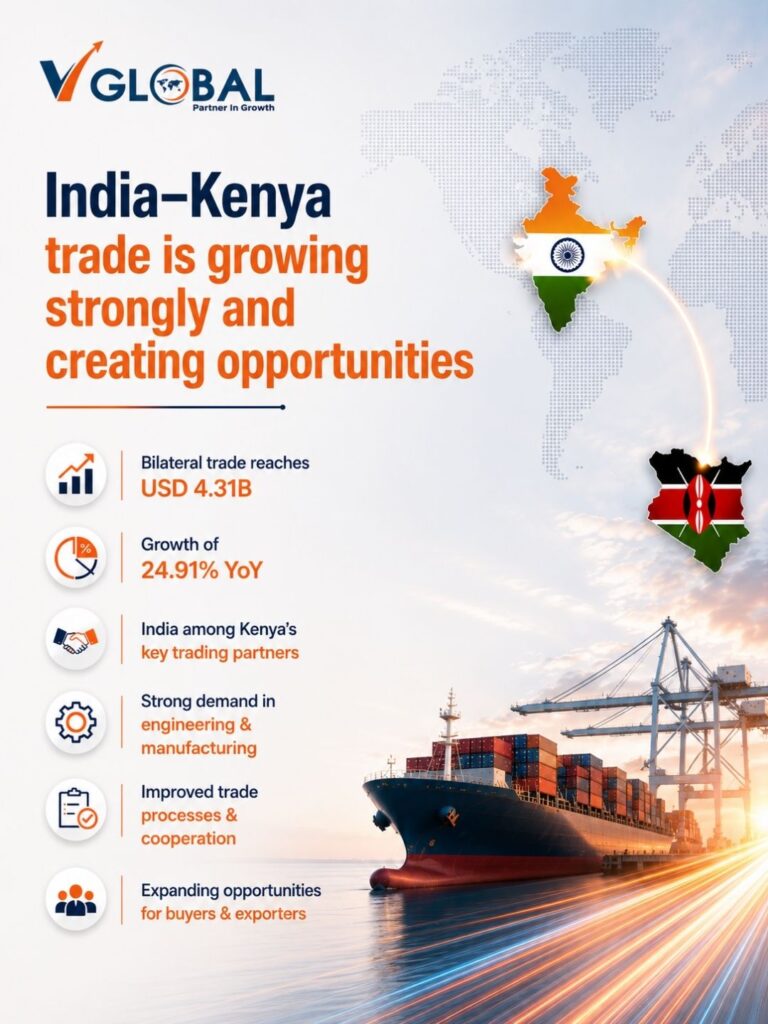
India–Kenya bilateral trade has now reached USD 4.31 billion in FY 2025–26, recording a strong 24.91% year-on-year growth from USD 3.45 billion in the previous year. (Commerce Ministry)
At first glance, these numbers may seem like just another trade statistic. But if you look deeper, they reflect something far more important:
👉 A rapidly strengthening economic partnership between India and East Africa.
And for Indian exporters, especially MSMEs and manufacturers, this could become one of the most strategic growth opportunities of the next decade.
Kenya Is More Than a Market, It’s a Gateway
One of the biggest misconceptions exporters make is viewing Kenya only as a standalone destination. In reality, Kenya functions as a commercial gateway to the wider East African region.
Its strategic location and trade connectivity provide access to:
- East African Community (EAC) markets
- COMESA region
- Growing African consumer and industrial demand
For Indian businesses, this means the opportunity is not limited to one country.
A successful presence in Kenya can become a launchpad into broader African markets. And that matters because Africa is no longer just an “emerging” opportunity.
It is becoming one of the fastest-growing regions for:
- infrastructure development
- industrialization
- healthcare expansion
- energy transition
- manufacturing demand
The Real Opportunity for Indian Manufacturers
The recent India–Kenya Joint Trade Committee (JTC) meeting held in Nairobi in April 2026 highlighted several sectors where cooperation is expected to deepen.
This is particularly relevant for Indian manufacturers because Kenya’s demand profile aligns closely with India’s export strengths.
Sectors seeing increasing opportunity include:
- engineering goods
- industrial machinery
- electrical equipment
- auto components
- pharmaceuticals and medical devices
- agriculture and food processing technologies
- renewable energy solutions
India already has a strong reputation in many of these industries, especially in affordable engineering, generic medicines, and cost-effective manufacturing.
The next phase is not just exporting products.
It’s becoming part of Africa’s long-term industrial growth story.
Trade Facilitation Is Quietly Improving
One of the most significant developments is not just rising trade volume, but improving trade systems.
During the recent bilateral discussions, India and Kenya signed and advanced multiple cooperation agreements aimed at simplifying business processes.
These include:
- cooperation between the Bureau of Indian Standards (BIS) and the Kenya Bureau of Standards (KEBS)
- customs information-sharing agreements between CBIC and the Kenya Revenue Authority (KRA)
- discussions around local currency trade settlement mechanisms
For exporters, these developments may sound technical.
But practically, they mean:
- smoother customs procedures
- reduced delays
- better compliance alignment
- easier movement of goods
And in international trade, reduced friction often matters as much as reduced tariffs.
Why This Matters for MSMEs
For many MSMEs, entering developed markets can feel expensive and highly competitive.
Africa offers something different.
It offers:
- growing demand
- lower saturation in many sectors
- infrastructure expansion
- increasing openness to Indian businesses
But perhaps most importantly:
👉 Indian products are already trusted across many African markets.
That trust creates a foundation that smaller exporters can build on.
However, entering these markets successfully requires preparation.
Exporters need to:
- understand local standards and certifications
- build distributor partnerships
- participate in trade forums and B2B networks
- think long-term rather than transactionally
Because Africa is not a “quick-win” export market.
It is a relationship-driven market.
A Bigger Shift Is Happening
If you step back, the India–Kenya partnership reflects a broader transformation in global trade.
Supply chains are diversifying. Emerging markets are becoming growth centers.
And countries are increasingly looking for:
- reliable manufacturing partners
- affordable technology
- scalable infrastructure support
India fits naturally into that role. Not only because of pricing.
But because of:
- manufacturing capability
- technical expertise
- adaptability
- growing geopolitical trust
The Real Question Exporters Should Ask
Most exporters ask:
👉 “How much can we sell in Kenya?”
But the more important question is:
👉 “How can Kenya become our entry point into East Africa?”
Because the real opportunity is not one shipment.
It’s long-term regional positioning.
Final Thought
India–Kenya trade growth is not just about bigger numbers.
It signals something larger:
a gradual but meaningful shift in how India is expanding its global trade footprint.
For exporters willing to move early, build relationships, and understand the market deeply, Kenya may become far more than a destination. It may become a strategic anchor for Africa.
👉 If you’re exploring African markets and unsure where to begin, clarity matters more than speed.
At V Global, we help exporters understand markets, navigate trade processes, and build practical export strategies for long-term growth.
Because global expansion works best when it’s approached strategically, not reactively.
#IndiaKenya #IndianExports #AfricaBusiness #GlobalTrade #MSME #ManufacturingIndia #EngineeringExports #PharmaExports #ExportStrategy #InternationalTrade #VGlobal