
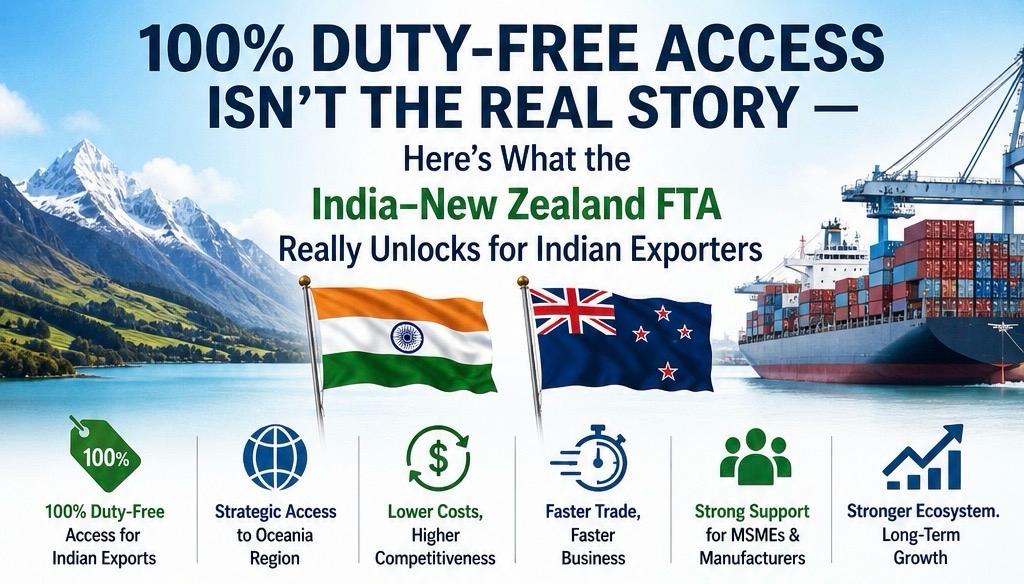
When a new Free Trade Agreement is announced, the conversation usually begins and ends with tariffs.
“How much duty is reduced?”
“What products get zero duty?”
But if you look at the India–New Zealand FTA signed in April 2026, that’s only the surface. The real story is not about duty-free access.
It’s about what this agreement quietly unlocks for Indian exporters in terms of positioning, credibility, and long-term global strategy.
A Market That Looks Small But Isn’t
At first glance, New Zealand doesn’t stand out as a high-volume export destination. It’s a relatively small economy compared to the US or the EU. But that’s exactly where many exporters misjudge it.
New Zealand represents something different:
a high-income, quality-driven market with strong regulatory standards that often align with global benchmarks.
For Indian exporters, entering such a market is not just about sales
It’s about validation.
When your product meets New Zealand standards, it becomes easier to:
- build trust with other developed markets
- strengthen your brand positioning
- move up the value chain
This is not a volume play. It’s a credibility play. The Immediate Impact: Pricing, But Smarter
Yes, tariff reductions (where applicable under the agreement) do matter. They create room for better pricing strategies. But the advantage isn’t just about being cheaper. It’s about becoming more flexible in negotiations.
Exporters can:
- Adjust pricing without cutting margins too aggressively
- compete more confidently in tenders
- structure deals more strategically
In sectors like textiles, engineering goods, leather, and pharmaceuticals, even small pricing advantages can shift decisions. But the real benefit is not price reduction
It’s pricing control.
A Hidden Lever: Smarter Supply Chains
One of the less discussed aspects of FTAs is how they influence sourcing. Access to inputs, raw materials, and trade flows across partner networks allows exporters to rethink their cost structures.
Over time, this can:
- stabilize input costs
- improve product consistency
- reduce dependence on volatile sources
This is where exporters move from reacting to costs…
to managing them proactively. And in global trade, that shift is critical. Manufacturing Is No Longer Just Production. The FTA also fits into a larger shift happening in India’s export strategy. There’s increasing focus on value addition within India, not just assembly or low-margin exports.
Agreements like this support:
- stronger manufacturing ecosystems
- deeper integration with global supply chains
- higher-value exports instead of commodity dependence
Manufacturing today is not just about output. It’s about relevance in global value chains. Speed, Simplicity, and Reliability. Modern trade agreements are no longer limited to tariffs. They are also about how efficiently goods move across borders.
While implementation evolves over time, the direction is clear:
- more digitization
- smoother customs processes
- reduced documentation friction
For exporters, this translates into something very practical:
👉 predictability
And in international trade, predictability often matters more than price. Because buyers value suppliers who can deliver consistently, not just cheaply.
Why This Matters for MSMEs
Perhaps the most important shift is how agreements like this open doors for smaller exporters. In the past, entering premium markets required scale, networks, and heavy investment. That barrier is gradually lowering.
With the right support, MSMEs can:
- connect with new international buyers
- improve compliance standards
- participate in structured global supply chains
But this doesn’t happen automatically. It requires operational, financial, and strategic.
The Bigger Picture: A Shift in Global Trade Thinking
If you step back, this FTA reflects a deeper transformation.
Global trade is moving:
From market access → to supply chain integration
From price competition → to value positioning
From one-time exports → to long-term partnerships
This is the real shift.
And this is where many exporters still focus too narrowly on tariffs.
A More Important Question to Ask
Instead of asking:
👉 “How much duty benefit do I get?”
A better question might be:
👉 “How does this help me become more competitive globally?”
Because in today’s environment, success is not defined by how many markets you enter. It’s defined by how strongly you position yourself within those markets.
The India–New Zealand FTA is not just about opening a new destination.
It’s about offering Indian exporters a chance to:
- build credibility in premium markets
- improve operational standards
- strengthen their role in global supply chains
The opportunity is real.
But it will not be captured by those who focus only on tariffs. It will be captured by those who understand what the agreement enables beyond them. If you’re exploring new markets and unsure how to position your products globally, clarity matters more than speed.
At V Global, we work with exporters to translate opportunities like these into practical strategies, not just theoretical advantages.
Because in global trade, understanding the shift is often more valuable than reacting to it.