
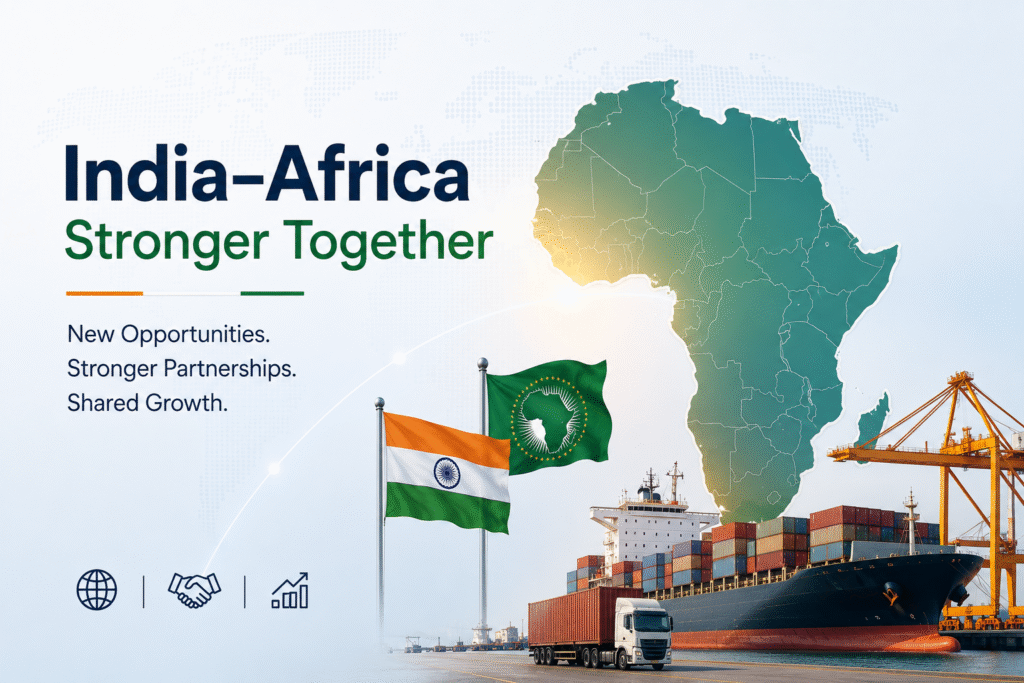
From Exporting Products to Building Long-Term Trade and Manufacturing Partnerships
India’s economic engagement with Africa is entering an important new phase.
For years, the India–Africa trade relationship has been driven by commodities, pharmaceuticals, machinery, petroleum products and other merchandise. Today, however, the opportunity is becoming broader.
The conversation is increasingly moving beyond simply “What can India export to Africa?”
The more strategic question is:
“Where can Indian manufacturers and African businesses create long-term value together?”
Recent India–Africa engagements have highlighted opportunities across manufacturing, MSMEs, infrastructure, healthcare, logistics, digital technologies, clean energy and critical minerals.
For Indian exporters and manufacturers looking for their next growth markets, Africa deserves serious attention.
But succeeding in Africa requires something more important than simply identifying a continent with growing demand.
It requires choosing the right country, right product, right buyer and right market-entry strategy.
Why Africa Is Becoming Important for Indian Businesses
Africa represents a diverse group of economies at different stages of industrial and infrastructure development.
Across several African markets, demand continues to develop for products and solutions related to:
- Infrastructure
- Industrial manufacturing
- Healthcare
- Agriculture
- Energy
- Transportation
- Construction
- Consumer goods
- Digital technology
At the same time, India has established capabilities across engineering, pharmaceuticals, machinery, automotive products, chemicals, technology and manufacturing.
This creates natural areas of commercial complementarity.
For Indian businesses, the opportunity is therefore not limited to exporting finished products.
It can also include:
- Distribution partnerships
- Local assembly
- Technology collaboration
- Contract manufacturing
- Joint ventures
- Project supply
- Long-term industrial partnerships
This represents a significant shift from transaction-based exporting toward strategic market development.
1. Engineering Goods & Industrial Equipment
Engineering is one of the most interesting areas for Indian manufacturers exploring African markets.
As countries invest in infrastructure, industrial capacity, agriculture, utilities and construction, demand can emerge for products such as:
- Industrial machinery
- Pumps and valves
- Pipes and fittings
- Electrical equipment
- Automotive components
- Construction equipment
- Agricultural machinery
- Metal and fabricated products
- Process equipment
- Industrial components
India already has a large and diverse engineering manufacturing ecosystem.
For African importers and distributors, Indian manufacturers can offer an alternative sourcing base across both standardized and customized industrial products.
For Indian exporters, however, the opportunity should be evaluated country by country and product by product rather than treating Africa as one homogeneous market.
2. Pharmaceuticals & Healthcare
Healthcare has long been an important pillar of India–Africa economic engagement.
India’s capabilities in pharmaceuticals, generic medicines, medical products and healthcare services can complement the growing healthcare requirements of African markets.
Potential areas include:
- Pharmaceutical products
- Generic medicines
- Medical devices
- Diagnostic equipment
- Hospital supplies
- Healthcare technology
But healthcare exports also demonstrate why market research is essential.
Registration procedures, product standards, procurement systems and distribution channels can differ considerably between African countries.
Exporters therefore need to understand the regulatory environment before entering individual markets.
3. Agriculture & Food-Processing Technology
Agriculture remains an important economic sector across much of Africa.
This creates potential opportunities for Indian businesses supplying:
- Agricultural machinery
- Irrigation equipment
- Pumps
- Food-processing machinery
- Packaging equipment
- Cold-chain solutions
- Storage systems
The larger opportunity may not simply be exporting equipment.
Indian companies can also explore partnerships that help create local processing and value addition.
This can turn a traditional supplier relationship into a longer-term industrial partnership.
4. Energy & Infrastructure
Africa’s infrastructure and energy requirements create another area of potential cooperation.
Opportunities can emerge across:
- Solar equipment
- Renewable-energy systems
- Power infrastructure
- Electrical equipment
- Transmission-related products
- Transportation infrastructure
- Water-management systems
- Construction-related products
For engineering companies, EPC businesses and component manufacturers, these sectors can provide opportunities beyond traditional product exports.
The ability to provide technical support, customization and reliable after-sales service can become an important differentiator.
5. Critical Minerals & Future Supply Chains
Critical minerals are becoming increasingly important to global manufacturing.
They are essential to industries including:
- Electric vehicles
- Batteries
- Electronics
- Renewable energy
- Advanced manufacturing
Several African countries possess significant mineral resources, while India is expanding its manufacturing capabilities across clean energy, mobility and technology.
This creates the possibility of a deeper relationship.
Instead of simply importing raw materials, future cooperation could potentially include:
mineral resources → processing → manufacturing → global supply chains
For both regions, greater value addition can create stronger and more sustainable economic partnerships.
Africa Is Not One Market
This is perhaps the most important point for any Indian company considering Africa.
Africa cannot be approached as a single export market.
A strategy that works in Kenya may not work in Nigeria.
A product that has strong demand in South Africa may have limited opportunity in Tanzania or Ghana.
Countries differ in:
- Import demand
- Regulations
- Duties and taxes
- Product standards
- Competition
- Distribution structures
- Buyer behaviour
- Payment practices
- Logistics
- Currency and commercial risks
Therefore, the first step should not be:
“We want to export to Africa.”
It should be:
“Which African country offers the strongest opportunity for our specific product?”
That difference in thinking can save exporters considerable time, money and effort.
What Indian Exporters Should Do Before Entering Africa
A structured market-entry strategy is essential.
1. Select the Right Country
Analyse actual import demand, market size, competition, tariffs, regulations and growth potential before deciding where to enter.
2. Understand Your Product Opportunity
A growing economy does not automatically mean there is demand for every Indian product.
Exporters should study product-specific import trends and buyer requirements.
3. Identify the Right Buyer Type
Depending on the product, the right customer may be:
- Importers
- Distributors
- Wholesalers
- OEMs
- Contractors
- Project companies
- Government procurement organisations
- Industrial end users
Finding the correct buyer category is often more important than simply creating a large database of companies.
4. Study Competition
Exporters should understand:
- Which countries currently supply the market?
- Who are the major competitors?
- What price levels exist?
- What specifications do buyers expect?
- Where can an Indian manufacturer differentiate?
5. Understand Compliance
Before approaching buyers, manufacturers should check applicable certifications, standards, labelling, documentation and product-registration requirements.
6. Build Long-Term Relationships
Many international markets reward consistency and trust.
Exporters should think beyond obtaining the first order and focus on building distributor relationships, repeat business and local market knowledge.
What This Means for African and International Buyers
The opportunity is not one-sided.
For buyers seeking to diversify their supplier networks, India offers a large manufacturing ecosystem across:
- Engineering products
- Pharmaceuticals
- Automotive components
- Chemicals
- Industrial machinery
- Electrical products
- Food-processing equipment
- Technology and services
The changing India–Africa relationship could create opportunities for buyers to develop longer-term sourcing and manufacturing partnerships with Indian companies.
However, buyers should continue evaluating manufacturers carefully on:
- Quality
- Manufacturing capacity
- Certifications
- Technical capability
- Delivery reliability
- Documentation
- Communication
- Export experience
Successful international sourcing is built on supplier capability not nationality alone.
From Export Destination to Strategic Partnership
The biggest opportunity in India–Africa trade may ultimately be the change in how businesses view the relationship.
The traditional model was:
India → Product → African Buyer
The emerging opportunity can be much broader:
India + Africa → Manufacturing + Technology + Investment + Supply Chains
That could mean Indian manufacturers partnering with African distributors, setting up local assembly, providing technology, participating in infrastructure projects or developing regional supply chains. This is where long-term value can be created
Africa represents an important opportunity for Indian exporters and manufacturers but success will not come from treating the continent as one large market.
The companies most likely to succeed will be those that:
✔ Choose markets based on data
✔ Understand product-specific demand
✔ Identify genuine buyers
✔ Study regulations and competition
✔ Develop market-specific strategies
✔ Build long-term partnerships
The question for Indian exporters should therefore evolve from:
“How can we export to Africa?”
to:
“Which African market is right for our product—and how can we build a sustainable business there?”
That is where a more intelligent India–Africa trade strategy begins.
How V Global Supports International Trade
At V Global, we help Indian manufacturers and exporters make informed international market decisions through country selection, market intelligence, competitor analysis, buyer identification and export strategy.
For international buyers, we help identify and evaluate suitable Indian manufacturing partners based on sourcing requirements.
Our focus is simple: better market intelligence, better trade decisions and stronger long-term international partnerships.