
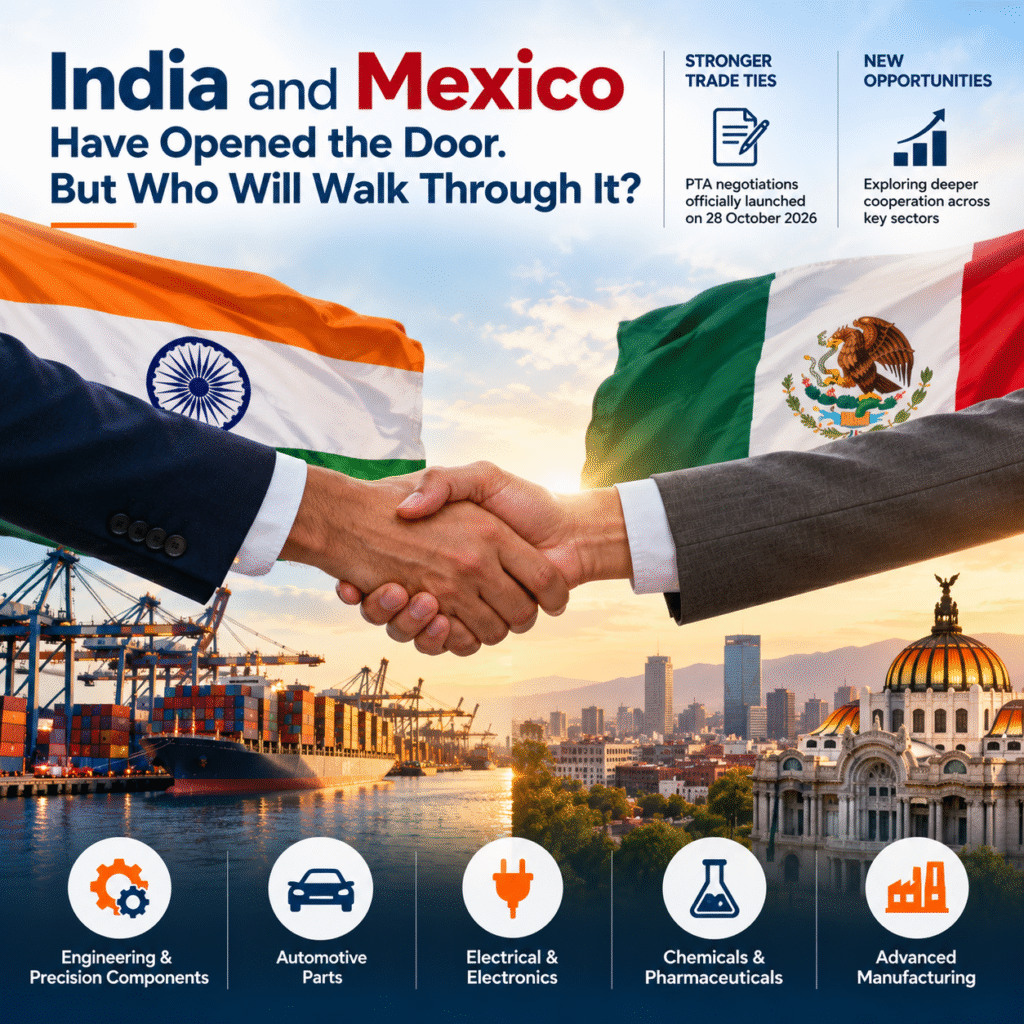
India and Mexico have officially launched negotiations for a Preferential Trade Agreement. Could this be the beginning of stronger manufacturing and sourcing partnerships between the two countries?
On 28 October 2026, India and Mexico formally launched negotiations for a Preferential Trade Agreement (PTA) by signing the Terms of Reference.
This development marks an important step towards strengthening bilateral trade and industrial cooperation.
For Indian exporters, particularly manufacturers of engineering goods, automotive components and industrial products, Mexico represents a market worth exploring.
But there is an important distinction.
The negotiations have begun. A new trade agreement has not yet been signed or implemented.
That means Indian businesses should focus on preparing for potential opportunities rather than assuming immediate tariff reductions.
Why Is Mexico Important for Indian Manufacturers?
Mexico is one of North America’s major manufacturing centres, with established industries across automotive, electronics, machinery and industrial production.
Its close integration with regional supply chains makes it relevant for Indian companies looking to expand beyond traditional export destinations.
India already exports products such as automobiles, engineering goods, pharmaceuticals and chemicals to Mexico.
A future PTA could strengthen these commercial relationships, depending on the final negotiated provisions.
For Indian manufacturers, the bigger opportunity is not simply exporting more products.
It is becoming a reliable supplier to companies that already operate within Mexico’s manufacturing ecosystem.
1. Engineering and Precision Components
Indian manufacturers have established capabilities in precision machining, brass and metal components, industrial fittings, fasteners and custom-engineered products.
These capabilities may align with requirements from Mexican OEMs, industrial distributors and component manufacturers.
However, entering the market requires understanding product specifications, quality expectations, import regulations and existing supplier competition.
The opportunity lies in identifying buyers whose requirements genuinely match Indian manufacturing capabilities.
2. Automotive and Electrical Supply Chains
Mexico has significant automotive and electronics manufacturing activity.
Indian suppliers of automotive parts, electrical accessories, connectors, cable-management products and precision components can investigate opportunities with manufacturers and their supply networks.
For these buyers, competitive pricing alone may not be sufficient.
Technical documentation, material consistency, production capacity and dependable delivery are equally important.
A well-qualified Indian supplier could become an additional sourcing partner for Mexican manufacturers.
3. Supplier Diversification for Mexican Buyers
International procurement teams increasingly evaluate supply-chain resilience alongside price and product quality.
For Mexican businesses, qualified Indian manufacturers may offer an additional sourcing option across selected industrial product categories.
This does not necessarily mean replacing existing suppliers.
It may mean introducing a second manufacturing source to improve flexibility, manage sourcing risks and support future production requirements.
The strongest sourcing relationships are built on consistent performance, not simply the lowest quotation.
What Could the India–Mexico PTA Change?
The proposed agreement is expected to involve negotiations covering market access, Rules of Origin, customs procedures and related trade matters.
Depending on the outcome, the PTA could improve trade conditions for selected products.
However, tariff benefits cannot be assumed until the agreement is finalised and its product-specific provisions are published.
Exporters must also account for Mexico’s existing import tariffs, product standards, customs requirements and landed costs.
A preferential agreement may improve competitiveness, but it does not automatically guarantee lower total sourcing costs or new orders.
What Should Indian Exporters Do Now?
Rather than waiting for negotiations to conclude, manufacturers can begin evaluating the Mexican market.
A practical approach involves five steps:
- Identify product-level demand: Research which products Mexico imports using the correct HS codes.
- Analyse existing competition: Identify major supplying countries and their advantages.
- Find relevant buyers: Focus on OEMs, industrial distributors, importers and procurement decision-makers.
- Evaluate supplier readiness: Review certifications, technical capabilities, production capacity and delivery performance.
- Monitor PTA developments: Track future tariff concessions and product-specific eligibility requirements.
This preparation can help businesses make more informed decisions about entering Mexico.
How V Global Supports International Market Expansion
At V Global, we believe trade agreements create possibilities, but market intelligence helps businesses identify genuine commercial opportunities.
Our focus is on connecting Indian manufacturing capabilities with international buyer requirements through:
- Export market and import-demand research
- Buyer identification and qualification
- Product and competitor analysis
- International sourcing strategy
- Supplier capability assessment
- Long-term B2B business development
For Indian manufacturers, the objective is to approach the right buyers with a competitive and credible offering.
For international buyers, it is to identify dependable manufacturing partners capable of meeting their requirements.
Final Thoughts: The Opportunity Begins Before the Agreement
The launch of India–Mexico PTA negotiations is an encouraging development for bilateral trade.
But businesses should not wait for an agreement to be signed before studying the market.
Governments negotiate trade access. Businesses build the partnerships that turn access into export orders.
For Indian manufacturers, the most useful question today is not simply whether Mexico will reduce tariffs.
It is:
Which Mexican companies are already buying products like ours, and what would it take to become their trusted supplier?
Explore international market intelligence, buyer identification and global sourcing opportunities with V Global.
Website: www.vglobalindia.in