
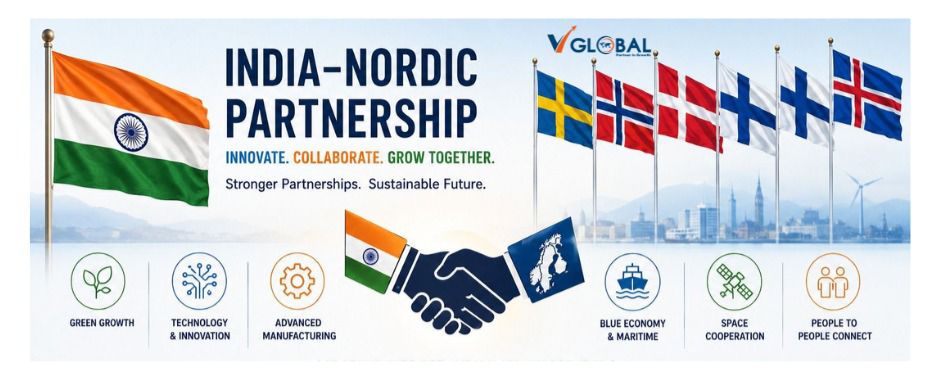
In today’s rapidly changing global economy, countries are no longer building partnerships based only on trade. The new era of international collaboration is being shaped by technology, sustainability, resilient supply chains, innovation, and long-term economic strategy.
This is exactly why the growing partnership between India and the Nordic countries is becoming increasingly important.
The recent India–Nordic discussions involving Sweden, Norway, Denmark, Finland, and Iceland highlight a shared vision for a future driven by green growth, advanced manufacturing, clean technology, digital transformation, and sustainable development.
For India, this partnership is more than diplomacy. It is a strategic opportunity to accelerate its manufacturing ambitions, strengthen technological capabilities, and position itself as a trusted global economic partner.
Why Nordic Countries Matter Globally
The Nordic region is globally recognized for:
- technological innovation,
- clean energy leadership,
- industrial efficiency,
- sustainable development,
- advanced engineering,
- digital transformation,
- and high-quality infrastructure.
Despite their smaller populations, Nordic nations consistently rank among the world’s most advanced economies in terms of:
- innovation,
- environmental sustainability,
- research and development,
- and industrial competitiveness.
Countries like Sweden, Norway, Denmark, Finland, and Iceland have built strong global reputations in sectors such as:
- renewable energy,
- telecom,
- maritime industries,
- semiconductors,
- AI,
- clean manufacturing,
- smart cities,
- and climate technology.
For India, partnering with such nations creates opportunities that go far beyond conventional trade relations.
What Was Discussed During the India–Nordic engagements?
The recent India–Nordic discussions focused on several strategic sectors that are expected to shape the global economy over the next decade.
1. Green Energy & Sustainability
Nordic countries are global leaders in renewable energy and climate-focused industrial solutions.
Discussions included:
- offshore wind energy,
- green hydrogen,
- sustainable manufacturing,
- green shipping,
- climate resilience,
- and clean energy collaboration.
This is especially important for India as the country accelerates its renewable energy transition and net-zero ambitions.
2. Advanced Manufacturing & Industrial Cooperation
India is actively working to strengthen its manufacturing ecosystem through initiatives such as:
- Make in India,
- Production Linked Incentive (PLI) schemes,
- Semiconductor Mission,
- and infrastructure modernization.
Nordic expertise in:
- industrial automation,
- precision engineering,
- smart factories,
- robotics,
- and sustainable industrial systems
can significantly help India move toward high-value manufacturing.
3. Telecom, AI & Emerging Technologies
Sweden and Finland are among the world’s strongest telecom and innovation hubs.
Key discussions involved:
- 6G development,
- AI collaboration,
- cybersecurity,
- quantum technologies,
- semiconductor ecosystems,
- and digital innovation.
As global technology supply chains diversify, India aims to position itself not just as a consumer market but also as a future hub for technology manufacturing and innovation.
4. Maritime & Blue Economy Cooperation
Norway and Denmark are leaders in maritime industries and green shipping technologies.
India and the Nordic countries discussed:
- sustainable ports,
- maritime logistics,
- offshore technologies,
- fisheries,
- Arctic cooperation
- and blue economy opportunities.
Given India’s strategic coastline and growing shipping ambitions, these collaborations could create long-term industrial and infrastructure benefits.
How Indian Manufacturers Can Benefit
One of the most important aspects of the India–Nordic partnership is the opportunity it creates for Indian manufacturers.
Access to Advanced Technologies
Indian companies can benefit from Nordic expertise in:
- automation,
- clean production systems,
- industrial digitalization,
- smart manufacturing,
- and sustainable engineering.
This can help Indian manufacturers improve:
- product quality,
- efficiency,
- and global competitiveness.
Export Growth Opportunities
Europe is increasingly prioritizing sustainable and trusted supply chains.
Indian manufacturers adopting:
- green manufacturing,
- ESG practices,
- clean energy systems,
- and advanced quality standards
will gain stronger access to Nordic and European markets.
Semiconductor & Electronics Ecosystem
With global semiconductor supply chains diversifying, India is positioning itself as a future hub for electronics and semiconductors.
Collaborations with technologically advanced nations can help India:
- build semiconductor capabilities,
- attract investments,
- strengthen electronics manufacturing,
- and improve technology transfer.
MSME & Startup Opportunities
The partnership is not limited to large corporations.
Indian MSMEs and startups can benefit through:
- joint ventures,
- innovation partnerships,
- technology collaborations,
- research programs,
- and clean-tech ecosystems.
Sectors such as:
- EV components,
- renewable energy equipment,
- industrial machinery,
- telecom hardware,
- marine technology,
- and sustainable packaging
could see significant opportunities.
Why This Partnership Is Strategically Important for India
The global economy is undergoing major changes.
Companies worldwide are now looking for:
- resilient supply chains,
- trusted manufacturing destinations,
- sustainable production ecosystems,
- and diversified sourcing beyond traditional hubs.
India offers:
- scale,
- skilled talent,
- infrastructure growth,
- and manufacturing potential.
Nordic countries offer:
- innovation,
- technology,
- sustainability leadership,
- and high-value industrial expertise.
Together, this creates a strong strategic partnership model for the future.
The Road Ahead
India’s next phase of economic growth will not be driven by low-cost manufacturing alone.
The future belongs to economies that can combine:
- innovation,
- sustainability,
- technology,
- resilience,
- and strategic partnerships.
The India–Nordic partnership represents exactly that future.
It reflects a shared vision where:
- India contributes scale, talent, and manufacturing strength,
- while Nordic nations contribute innovation, sustainability expertise, and advanced technologies.
As these partnerships deepen, India has an opportunity to emerge as:
- a global manufacturing hub,
- a clean technology leader,
- and a trusted partner in the future global economy.
The India–Nordic relationship is not just about diplomacy.
It is about building the foundation for the next generation of sustainable economic growth.