
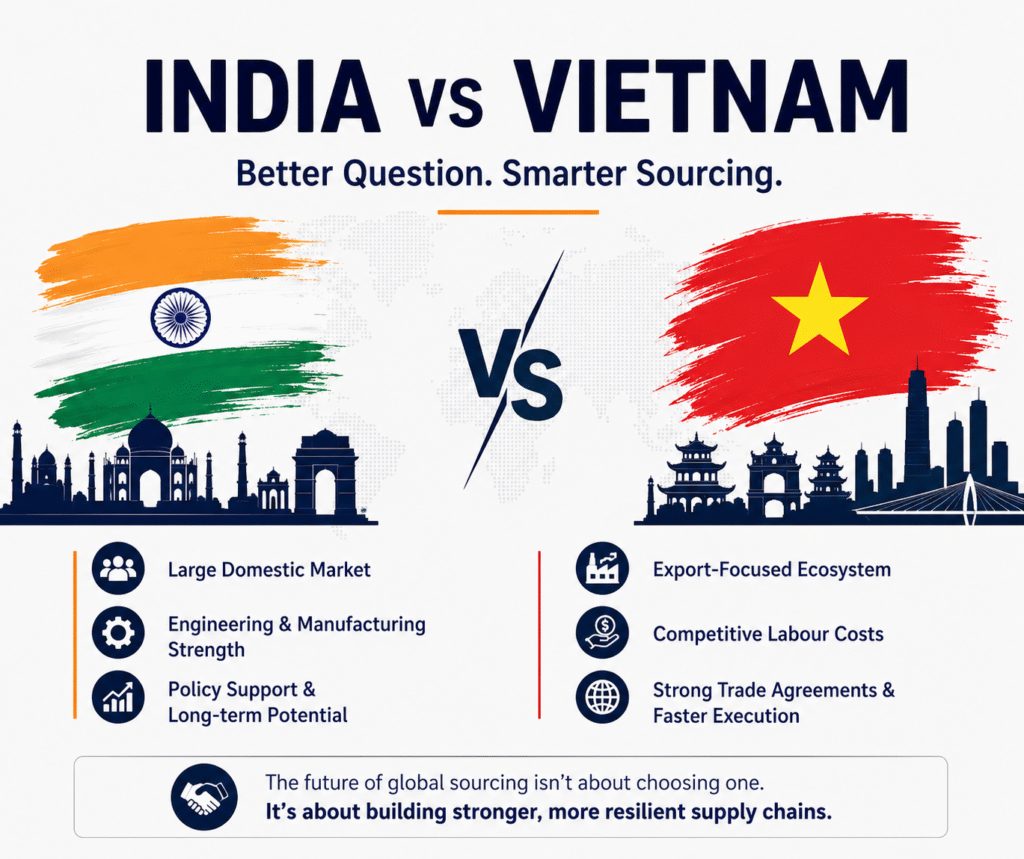
As Global Supply Chains Evolve, Where Should International Buyers Source From?
The global manufacturing landscape is changing rapidly.
Over the past few years, geopolitical tensions, supply chain disruptions, rising production costs, and the China+1 strategy have encouraged companies worldwide to diversify their manufacturing base.
Among the countries benefiting most from this shift are India and Vietnam.
Both nations have established themselves as attractive manufacturing destinations, but they offer different advantages to global buyers.
The real question is no longer:
“Is India better than Vietnam?”
Instead, procurement teams, importers, and manufacturers should ask:
“Which country aligns better with our long-term sourcing strategy?”
Understanding the strengths of each manufacturing hub can help businesses build resilient, cost-effective, and future-ready supply chains.
Why Are Global Buyers Looking Beyond China?
For decades, China dominated global manufacturing.
However, businesses today are increasingly prioritizing:
- Supply chain resilience
- Risk diversification
- Cost competitiveness
- Market access
- Long-term manufacturing partnerships
This has led to the rise of the China+1 strategy, where companies maintain operations in China while expanding manufacturing into other countries.
India and Vietnam have emerged as two of the strongest alternatives.
Vietnam: A Proven Export Manufacturing Hub
Vietnam has built an impressive reputation as an export-focused manufacturing economy.
Its strengths include:
- Competitive labour costs
- Well-developed industrial parks
- Efficient export infrastructure
- Multiple Free Trade Agreements (FTAs)
- Faster project approvals and implementation
These advantages have attracted significant investments in industries such as:
- Consumer electronics
- Mobile phones
- Garments
- Footwear
- Furniture
For businesses looking for export-oriented assembly operations, Vietnam offers a mature manufacturing ecosystem.
India: Manufacturing with Scale and Long-Term Growth
India offers a fundamentally different value proposition.
Unlike many manufacturing destinations, India combines large-scale manufacturing capabilities with one of the world’s largest consumer markets.
Its strengths include:
- Population of over 1.4 billion
- Large engineering and technical workforce
- Strong industrial ecosystem
- Production Linked Incentive (PLI) schemes
- Significant investments in highways, ports, railways, and logistics
- Rapid digital transformation
- Growing network of international trade agreements
This combination allows businesses to manufacture in India while serving both domestic and international markets.
For many global companies, India is becoming more than a production base it is a strategic growth market.
Industries Where India Has a Competitive Advantage
India has developed strong capabilities across several high-value manufacturing sectors.
These include:
- Engineering Goods
- Industrial Machinery
- Automotive Components
- Electrical Equipment
- Pharmaceuticals
- Chemicals
- Renewable Energy Equipment
- Precision Manufacturing
- Industrial Components
These industries benefit from India’s engineering expertise, skilled workforce, and well-established supplier ecosystem.
India vs Vietnam: A Practical Comparison
| Factor | India | Vietnam |
|---|---|---|
| Domestic Market | Very Large | Smaller |
| Manufacturing Scale | High | Medium |
| Engineering Capability | Strong | Moderate |
| Skilled Technical Workforce | Extensive | Growing |
| Export Ecosystem | Expanding Rapidly | Highly Mature |
| Labour Costs | Competitive | Highly Competitive |
| Infrastructure | Improving Rapidly | Well Established |
| Long-Term Growth Potential | Very High | High |
Both countries offer significant advantages, but they are designed to serve different sourcing strategies.
The Rise of the “China + India + Vietnam” Strategy
One of the biggest shifts in global manufacturing is that companies are not choosing India over Vietnam.
Instead, many multinational companies are investing in both.
A growing sourcing strategy looks like this:
- China for existing production capacity
- Vietnam for export-oriented manufacturing
- India for engineering-intensive manufacturing, product development, and long-term market expansion
This diversified approach reduces supply chain risks while improving flexibility.
What This Means for International Buyers
Today’s sourcing decisions involve much more than comparing labour costs.
Global buyers now evaluate suppliers based on:
- Manufacturing capability
- Product quality
- Engineering support
- Production scalability
- Infrastructure
- Logistics
- Reliability
- Long-term partnership potential
India is increasingly becoming a preferred destination for buyers seeking reliable suppliers capable of delivering complex engineering products, customized manufacturing, and large-scale production.
What This Means for Indian Manufacturers
For Indian manufacturers, the global supply chain transformation presents a significant opportunity.
As multinational companies diversify their sourcing networks, Indian businesses can position themselves as:
- Strategic manufacturing partners
- Long-term suppliers
- Engineering solution providers
- Participants in global value chains
Success will increasingly depend on:
- Consistent product quality
- Competitive pricing
- Innovation
- Reliable delivery
- Strong customer relationships
Manufacturers that invest in these areas will be better positioned to benefit from the next wave of global manufacturing investments.
Frequently Asked Questions
Is India better than Vietnam for manufacturing?
There is no single answer. Vietnam offers advantages in export-oriented manufacturing and efficient execution, while India provides manufacturing scale, engineering expertise, policy support, and access to one of the world’s largest consumer markets. The right choice depends on your sourcing objectives.
Why are global companies investing in India?
Companies are attracted by India’s skilled workforce, expanding infrastructure, Production Linked Incentive (PLI) schemes, growing manufacturing ecosystem, and strong long-term market potential.
Which industries are strongest in India?
India has established strengths in engineering goods, automotive components, pharmaceuticals, chemicals, industrial machinery, electrical products, and renewable energy equipment.
What is the China+1 strategy?
China+1 is a sourcing strategy where businesses diversify manufacturing beyond China to reduce geopolitical risks, improve supply chain resilience, and access new manufacturing ecosystems.
Final Thoughts
The future of global manufacturing is unlikely to belong to a single country.
Instead, it will be driven by diversified supply chains, regional manufacturing hubs, and trusted supplier partnerships.
India and Vietnam will both continue to play important roles in global manufacturing.
However, India’s unique combination of manufacturing capability, engineering expertise, policy support, infrastructure development, and domestic market size positions it as a strategic long-term sourcing destination.
The conversation should no longer be “India vs Vietnam.”
The better question is:
“How can global buyers leverage the strengths of both countries to build smarter, more resilient supply chains?”
For Indian manufacturers, this is more than a market trend—it is a once-in-a-generation opportunity to become trusted partners in the global manufacturing ecosystem.
Companies that focus on quality, innovation, and long-term relationships today will be best positioned to capture the opportunities of tomorrow.
Looking to Source from India?
At V Global, we help international buyers identify reliable Indian manufacturers through supplier verification, market intelligence, factory sourcing, and buyer development services.
Whether you’re looking to diversify your supply chain or expand your sourcing network, our team helps you make informed, confident sourcing decisions.
Explore trusted manufacturing partners with V Global and build a stronger global supply chain.