
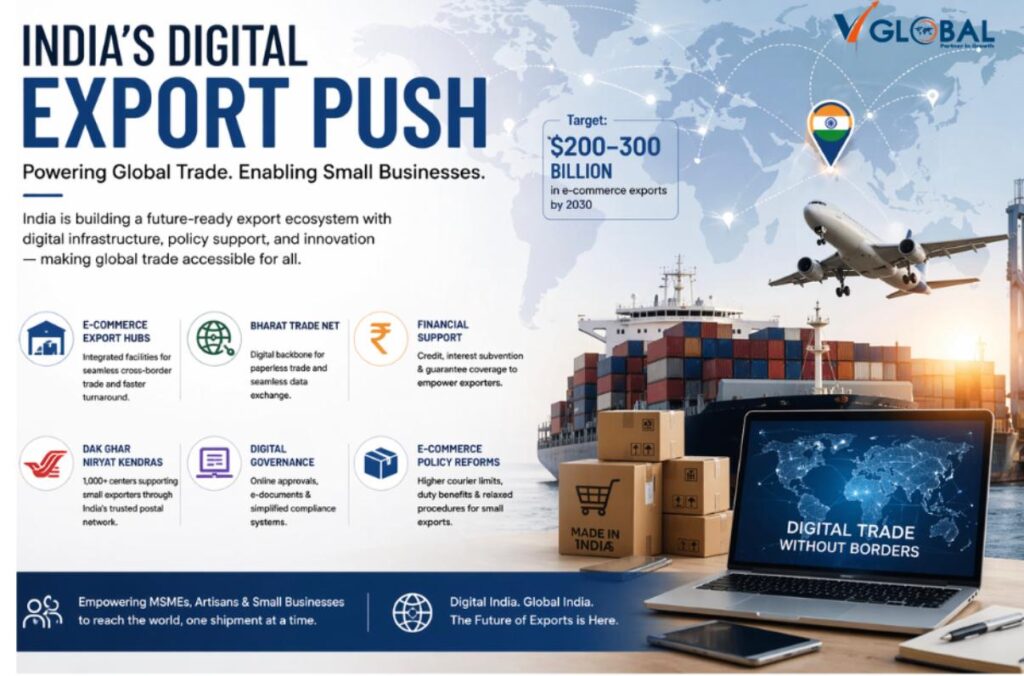
India is aiming big.
There’s a strong policy push to grow e-commerce exports toward the $200–300 billion range by 2030.
But it’s important to understand this clearly:
This is a target and direction, not a current reality.
What’s actually happening is more interesting. India is building the systems that can make this possible, especially for MSMEs. And for the first time, small exporters, artisans, and manufacturers are being brought into the global trade ecosystem in a meaningful way.
Why This Matters (In Simple Terms)
A few years ago, exporting meant:
- Large volumes
- Heavy documentation
- High logistics costs
- Dependence on intermediaries
Today, that model is changing. You can now:
- Export in smaller quantities
- Use digital platforms
- Access simplified systems
- Get financial and policy support
This shift is real but still evolving, not fully mature.
1. E-Commerce Export Hubs (ECEHs) Planned, Not Fully Rolled Out Yet
The government has proposed E-Commerce Export Hubs.
Important clarification: These are in pilot/proposal stage, not fully operational nationwide yet
What they aim to do:
- Combine customs, logistics, and packaging in one place
- Simplify returns and re-imports
- Reduce export turnaround time
Reality check: Great idea, but exporters should treat this as future infrastructure, not immediate support.
2. Bharat Trade Net (BTN) Under Development
Bharat Trade Net is being positioned as a digital backbone for trade.
What is expected:
- Digitization of multiple trade documents
- Seamless data sharing across agencies
- Reduced paperwork
Reality check: This is still in the development phase, not fully live at scale.
3. Financial Support (Niryat Protsahan / EPM)
This is where things become more practical.
What is active / emerging:
- Interest subvention (~2.75%) → recently announced under export credit schemes
- Credit access through banks
- Government-backed support for exporters
Important note: The full structure of EPM (Export Promotion Mission) is rolling out gradually. Not all exporters will see immediate access
4. Dak Ghar Niryat Kendras (DNKs) Active and Real
This is one of the most practical and already implemented initiatives.
Current status: 1000+ centers operational across India
What they do:
- Help with export documentation
- Support packaging
- Enable postal exports
For MSMEs: This is one of the easiest entry points into exports today.
5. Digital Governance (DGFT Systems) Active and Improving
This is already impacting exporters.
What’s working:
- Online approvals via DGFT
- Trade Connect portal (trade.gov.in)
- Digital documentation systems
Reality check: Systems are improving, but still not perfect. Expect faster processing, not zero friction
6. E-Commerce Policy Changes Partially Active
Confirmed updates:
- Courier export limit increased to ₹10 lakh per consignment
- RoDTEP / Duty Drawback extended to courier exports
RBI relaxations: Some simplifications exist, but are still evolving in practice
7. Digital Services Push Policy Direction, Not Full Scale Yet
- Tax incentives for digital infrastructure
- Simplified compliance frameworks
Still policy-led direction, not immediate MSME-level benefit for most manufacturers.
The Real Takeaway (Honest Version)
Let’s simplify everything into one clear truth:
India is not yet a fully frictionless export ecosystem. But it is moving strongly in that direction
What’s real today:
✔ Postal export support (DNKs)
✔ DGFT digital systems
✔ Higher courier limits
✔ Early-stage financial support
What’s coming:
⏳ E-commerce hubs
⏳ Bharat Trade Net
⏳ Deeper digital integration
What Should MSMEs Actually Do Now?
Don’t wait for the system to become perfect. Instead:
Start with what is already working:
1️⃣ Use DNKs or courier exports
2️⃣ Keep shipments small and frequent
3️⃣ Focus on clear documentation
4️⃣ Test international demand via marketplaces
Build gradually:
- Don’t scale too fast
- Learn compliance step-by-step
- Improve logistics understanding
You don’t need a big factory to go global anymore.
But you do need:
- Awareness
- Adaptability
- Patience
Because this is not an overnight transformation.
It’s a system being built in real time, and early movers will understand it better than late entrants.
If you’re confused about where to start, you’re not alone.
Most MSMEs are still figuring this out.
At V Global, we help businesses understand what’s practical today and what to prepare for tomorrow without overcomplicating things.
Reach out to us, and let’s build your export journey step-by-step.
#EcommerceExports #IndiaExports #MSMEExports #DigitalTrade #GlobalTrade #ExportGrowth #DGFT #MakeInIndia #VGlobal