
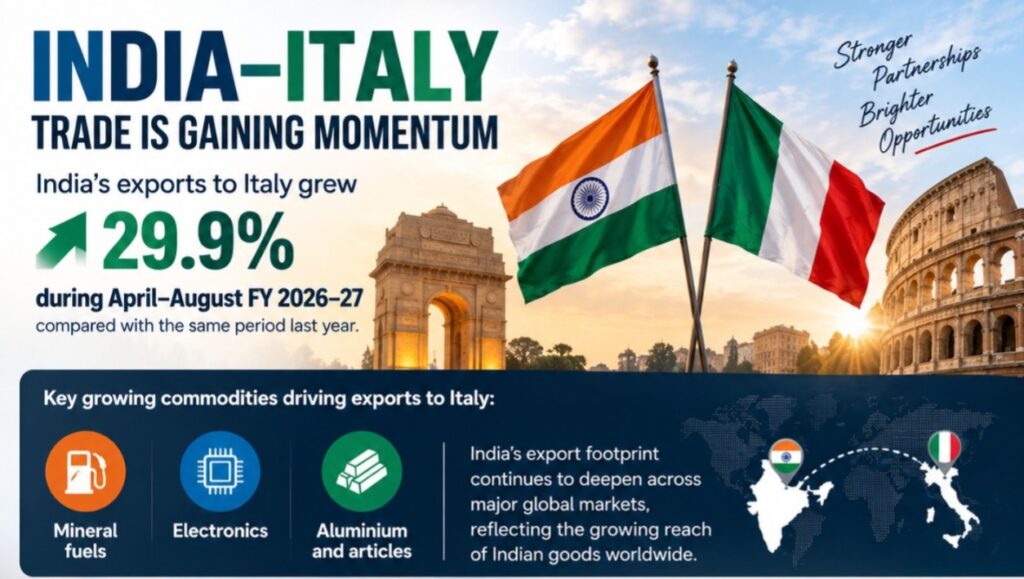
India’s export relationship with Italy is showing strong momentum.
During April–August FY 2026–27, India’s exports to Italy increased by 29.9% compared with the corresponding period of FY 2025–26, according to trade data highlighted by India’s Department of Commerce.
Among the product categories contributing to this growth were:
- Mineral fuels
- Electronics
- Aluminium and articles thereof
The numbers are encouraging. But for Indian exporters and manufacturers, the bigger question is not simply:
“How much did India’s exports to Italy grow?”
It is:
“Where is demand growing in Italy, and can Indian manufacturers convert that demand into long-term buyer relationships?”
That is where trade data becomes commercially useful.
India–Italy Trade Is Becoming More Important
Italy is not simply another European export destination.
It is one of Europe’s major manufacturing economies, with established industries across machinery, automotive, industrial equipment, electrical products, metals, engineering, food processing, fashion and other manufacturing sectors.
For Indian companies, this creates opportunities on both sides of the market.
Indian exporters can supply finished products, industrial components and materials. At the same time, Italian manufacturers and distributors can potentially use India as an alternative or additional sourcing base. The recent 29.9% growth in Indian exports to Italy therefore deserves attention beyond the headline number. It can be viewed as another signal of India’s expanding participation in international supply chains.
What Is Driving India’s Export Growth to Italy?
The recent data highlights several growing commodity groups.
1. Mineral Fuels
Mineral fuels were among the major commodities contributing to export growth during April–August FY 2026–27.
Energy-related trade can significantly influence headline export numbers, so manufacturers should be careful not to assume that a 29.9% rise means every Indian product category is experiencing the same growth.
That distinction is important.
A country’s total exports can grow rapidly while demand for an individual engineering product remains flat.
Therefore, exporters should always move from:
Country-level growth
to
Product-level analysis.
2. Electronics
Electronics were another important contributor to India’s export growth to Italy.
India’s growing electronics manufacturing ecosystem has increasingly become part of the country’s broader export story.
For manufacturers and suppliers, the opportunity may extend beyond finished electronic products into supporting supply chains involving components, assemblies, precision parts, electrical accessories and related manufacturing capabilities.
However, European technical and regulatory requirements must be evaluated product by product.
3. Aluminium and Articles
For V Global’s manufacturing audience, this is particularly interesting.
Aluminium and articles thereof were among the growing commodity categories in India’s exports to Italy during the period.
This category can cover a wide range of products, so exporters should avoid treating the entire HS chapter as one opportunity.
The right approach is to investigate specific products and HS codes.
For example, manufacturers may examine opportunities involving:
- Aluminium industrial components
- Precision-machined components
- Extruded components
- Fittings
- Profiles
- Fabricated parts
- OEM components
- Custom engineering parts
The key question is not whether Italy imports aluminium products.
It is:
Which aluminium products is Italy importing, from which countries, at what value, and who are the actual buyers?
Why Italy Matters for Indian Engineering Manufacturers
Italy has a strong manufacturing ecosystem.
That means opportunities do not necessarily exist only in selling finished products to Italian consumers.
For Indian engineering companies, one of the more interesting opportunities can be B2B industrial sourcing.
Consider an Italian manufacturer that needs thousands of precision components every year.
The company may currently source from:
- Domestic Italian manufacturers
- Other EU countries
- China
- Türkiye
- Other Asian suppliers
An Indian manufacturer does not necessarily need to replace all those suppliers.
India could potentially become an additional sourcing base.
That changes the export proposition. Instead of saying: “Buy this product from India.” The conversation becomes:
“Could India become a competitive and reliable second source for this component?” For procurement teams concerned about cost, capacity and supply-chain concentration, that can be a much more relevant discussion.
Export Growth Does Not Automatically Mean Opportunity for Every Manufacturer
This is where exporters need to be careful.
Seeing:
“India’s exports to Italy increased 29.9%”
does not mean:
“Italy is a good market for every Indian exporter.”
The 29.9% figure represents aggregate export performance during a particular period.
Before entering the Italian market, manufacturers should answer several more specific questions.
1. Is Italy Actually Importing Your Product?
Start with the product.
Identify the correct HS code.
Then examine Italy’s imports of that product.
Look at:
- Total annual imports
- Import growth
- Major supplier countries
- Average import values
- India’s current share
- Recent trends
This establishes whether there is genuine demand.
2. Who Currently Supplies Italy?
Knowing that Italy imports your product is only the beginning.
The next question is:
Who are you competing against?
If Italy’s major suppliers are Germany, China, Türkiye or another country, investigate why.
It could be:
- Price
- Geography
- Quality
- Certification
- Lead time
- Existing supplier relationships
- Product specialisation
- EU market access
Indian manufacturers should understand these factors before deciding how to position themselves.
3. Can India Compete on Landed Cost?
Factory price alone is not enough.
The Italian buyer ultimately evaluates the complete sourcing economics.
That can include:
**Product price
- freight
- customs duty
- insurance
- compliance
- inventory cost
- lead time
- quality risk**
An Indian manufacturer could have a lower factory price and still lose the business because of logistics, MOQ, delivery or compliance.
The reverse can also happen.
India may not offer the lowest factory price, but better manufacturing flexibility or customisation could make the overall proposition attractive.
4. Does the Product Meet European Requirements?
This is especially important when entering Italy and the wider EU market.
Depending on the product, manufacturers may need to consider applicable requirements involving:
- Product standards
- CE marking where applicable
- REACH
- RoHS
- Material specifications
- Test certificates
- Technical documentation
- Traceability
- Packaging and labelling
- Buyer-specific quality requirements
Exporters should verify the exact regulatory requirements for their product rather than assuming that one certification provides access to every European market.
5. Who Are the Actual Italian Buyers?
This is where export strategy often becomes weak. A manufacturer may know that Italy imports its product but still not know who purchases it. Potential buyers can include:
OEMs
Companies incorporating the component into their own equipment or finished products.
Distributors
Businesses supplying products to industrial customers through established distribution networks.
Importers
Companies directly sourcing products internationally.
Wholesalers
Businesses purchasing larger quantities for resale.
Engineering Companies
Companies sourcing components for industrial projects and equipment. The ideal buyer depends on the manufacturer’s product, production capability and commercial model.
From Trade Data to Buyer Intelligence
This is the approach we believe Indian exporters should increasingly follow.
INDIA → ITALY
is too broad.
Instead:
PRODUCT
↓
HS CODE
↓
ITALIAN IMPORT DEMAND
↓
COMPETITOR COUNTRIES
↓
BUYERS
↓
DECISION MAKERS
↓
SUPPLIER FIT
↓
OUTREACH
Now the exporter is not simply “trying Italy.” They are entering the market with evidence.
Don’t Start With 5,000 Italian Companies
One of the biggest mistakes exporters make is assuming that more leads automatically mean more opportunities. Imagine an Indian engineering manufacturer receives a database containing:
5,000 Italian companies.
That sounds valuable. But how many actually import the manufacturer’s product? How many purchase meaningful volumes? How many already source internationally? How many have requirements matching the manufacturer’s capability? How many are realistic prospects? After proper research, perhaps only 50 companies are highly relevant. And perhaps only 15–20 deserve immediate attention. Those companies can be far more valuable than thousands of generic contacts. At V Global, we see an important distinction:
A company name is not a buyer opportunity. Buyer intelligence requires understanding why that company could realistically purchase from India.
What Should Indian Manufacturers Do Now?
If Italy is a potential market for your business, the recent export growth provides a good reason to investigate it more closely. But do it systematically.
Step 1 — Identify Your Exact Product
Define the product and HS code.
Step 2 — Study Italy’s Import Demand
Understand market size, growth and import trends.
Step 3 — Analyse Competition
Identify which countries currently supply Italy.
Step 4 — Understand Market Requirements
Verify certifications, standards, documentation and buyer expectations.
Step 5 — Identify the Right Buyers
Focus on OEMs, importers, distributors or manufacturers that actually purchase your category.
Step 6 — Evaluate Your Competitive Position
Compare price, landed cost, MOQ, lead time, quality and customisation.
Step 7 — Build Personalised Outreach
Approach buyers based on their business and sourcing requirements not with a generic company introduction.
What Should Italian Buyers Look for in India?
This trade relationship also creates an opportunity for Italian procurement teams. India has manufacturing capability across a broad range of engineering categories. But selecting the right Indian supplier requires proper evaluation.
Buyers should examine:
Manufacturing Capability
Does the supplier genuinely manufacture the required product?
Quality Control
What inspection systems exist across incoming materials, production and final inspection?
Technical Capability
Can the factory work from drawings and meet required tolerances?
Certifications
Does the manufacturer hold relevant certifications, and are they valid for the product and application?
Production Capacity
Can the supplier maintain quality as volumes increase?
Export Experience
Does the manufacturer understand international documentation, packaging and logistics?
Communication
Can technical and commercial questions be handled quickly and accurately?
Delivery Reliability
Can the supplier consistently meet agreed lead times? Finding a lower price is easy. Finding a supplier capable of becoming a reliable long-term sourcing partner requires more work.
The Bigger Story: India’s Export Footprint Is Expanding
The Italy numbers should also be viewed within a broader trend.
India’s merchandise exports reached US$215.91 billion during April–August FY 2026–27, representing 17.85% year-on-year growth.
This suggests Indian goods are reaching global markets at increasing scale.
But India’s next export challenge is not simply increasing shipment value. It is converting manufacturing capability into buyer confidence.
That requires Indian manufacturers to become stronger in:
- International market research
- Quality consistency
- Certifications
- Technical documentation
- Delivery reliability
- Communication
- Buyer development
- Market-specific positioning
India can manufacture.
The next challenge is ensuring that international buyers understand where India can reliably fit into their supply chain.
How V Global Supports India–Italy Trade Opportunities
At V Global, we believe trade statistics should be the beginning of market research not the end. For Indian manufacturers evaluating Italy, our approach can include:
Market Intelligence
Understanding product demand, import trends and competitor countries.
Buyer Identification
Finding relevant Italian OEMs, importers, distributors and industrial buyers.
Buyer Prioritisation
Identifying which companies have the strongest fit with the manufacturer’s capability.
Competitor Analysis
Understanding where Italy currently sources the product.
Supplier Positioning
Determining how the Indian manufacturer can compete on quality, price, capability, lead time and reliability.
Buyer Outreach Strategy
Building relevant conversations with decision-makers rather than sending generic mass emails. For international buyers, V Global also helps identify and evaluate suitable Indian manufacturing partners.
Final Takeaway
India’s 29.9% export growth to Italy during April–August FY 2026–27 is encouraging. But exporters should look beyond the percentage.
The more valuable questions are:
What is Italy buying? Who is buying it? Where are they currently sourcing it from? And can an Indian manufacturer provide a better or more resilient sourcing option?
Because export growth at the country level creates attention. Product-level demand creates opportunity. And buyer-level intelligence is what can turn that opportunity into business.
Is Italy on your export-market strategy for FY 2026–27?