
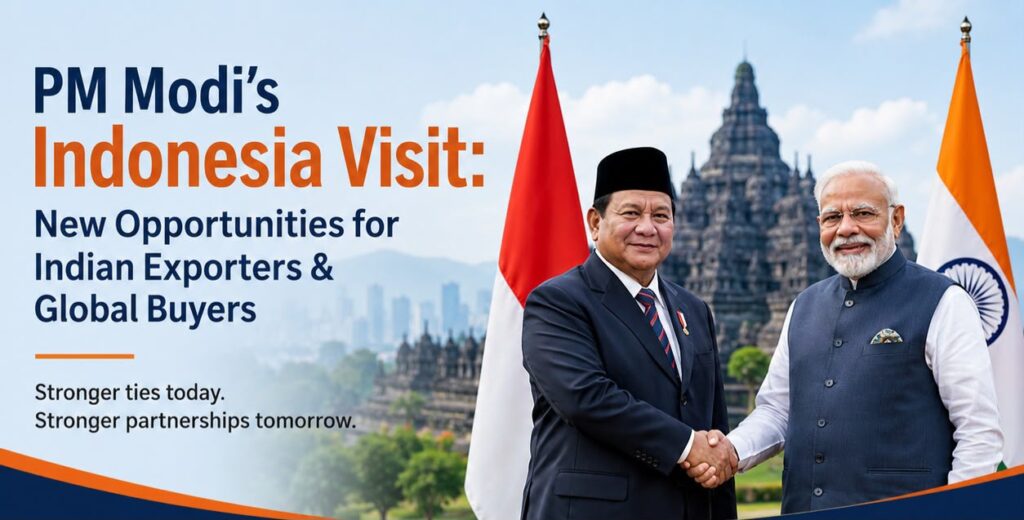
Strengthening India–Indonesia Trade Relations Opens New Opportunities Across Manufacturing, Engineering and Supply Chains
Prime Minister Narendra Modi’s recent visit to Indonesia marks an important step in strengthening the strategic and economic partnership between two of Asia’s fastest-growing economies.
While defence cooperation attracted significant media attention, the visit also delivered several outcomes that could have a lasting impact on Indian exporters, manufacturers, and international buyers.
From critical minerals and engineering collaboration to maritime connectivity and digital trade, the agreements signed during the visit reinforce India’s growing role in the Indo-Pacific supply chain.
For businesses involved in international trade, these developments deserve close attention.
Why Indonesia Matters to India
Indonesia is Southeast Asia’s largest economy and one of India’s most important strategic partners within ASEAN.
With a population of more than 280 million, growing industrial demand, and a strategic location along major global shipping routes, Indonesia offers significant opportunities for Indian businesses.
The country is also rich in natural resources and plays an important role in global supply chains for minerals, manufacturing, and clean energy.
As India continues to strengthen its Act East Policy, Indonesia is becoming an increasingly important economic partner.
Key Outcomes from PM Modi’s Indonesia Visit
1. Stronger Cooperation in Critical Minerals
One of the most significant outcomes of the visit was enhanced cooperation in critical minerals, including nickel and rare earth elements.
These minerals are essential for industries such as:
- Electric Vehicles (EVs)
- Battery manufacturing
- Renewable energy
- Electronics
- Advanced engineering
Indonesia is one of the world’s largest producers of nickel, making this partnership strategically important for India’s manufacturing ambitions.
What this means for Indian manufacturers
- Better access to critical raw materials
- Stronger EV supply chains
- Reduced dependence on limited global suppliers
- Improved long-term manufacturing resilience
2. New Opportunities for Engineering and Steel Manufacturing
Engineering and manufacturing received a major boost during the visit.
A strategic collaboration between Steel Authority of India Limited (SAIL) and Indonesia’s Krakatau Steel will support the development of a stainless-steel slab manufacturing facility in Indonesia.
In addition, both countries agreed to strengthen cooperation in:
- Steel production
- Industrial manufacturing
- Mineral processing
- Technology exchange
Why this matters
For Indian manufacturers of:
- Engineering goods
- Industrial machinery
- Construction equipment
- Metal products
- Industrial components
This partnership creates opportunities for future business collaboration and regional supply chain integration.
3. Better Maritime Connectivity
Efficient logistics are becoming one of the biggest competitive advantages in international trade.
India and Indonesia agreed to strengthen cooperation in:
- Maritime connectivity
- Port development
- Shipping
- Logistics
Particular attention was given to the strategically located Sabang Port, situated near one of the world’s busiest maritime routes.
Benefits for exporters
Better connectivity can lead to:
- Faster cargo movement
- Improved shipping efficiency
- Lower logistics complexity
- Better access to Southeast Asian markets
For exporters, stronger logistics often translates into improved delivery reliability and greater buyer confidence.
4. Expanding Digital Trade Cooperation
The two countries also agreed to deepen cooperation in digital technologies and payment systems.
This includes collaboration aimed at making cross-border business transactions more seamless.
Digital trade initiatives can support:
- Faster business transactions
- Easier commercial engagement
- Improved trade facilitation
- Enhanced financial connectivity
As global commerce becomes increasingly digital, these initiatives will become even more valuable.
What This Means for Indian Exporters
The visit creates opportunities across multiple sectors.
Industries likely to benefit include:
- Engineering Goods
- Steel Products
- Industrial Machinery
- Electrical Equipment
- Automotive Components
- Renewable Energy Equipment
- Electronics
- Chemicals
For exporters, the partnership offers:
✔ New market opportunities
✔ Improved regional connectivity
✔ Better access to industrial supply chains
✔ Increased collaboration with Southeast Asian businesses
✔ Stronger positioning within ASEAN markets
Why International Buyers Should Pay Attention
Global buyers are increasingly looking beyond traditional sourcing destinations.
They want suppliers that offer:
- Stable supply chains
- Engineering capability
- Manufacturing capacity
- Reliable logistics
- Long-term partnerships
India’s growing cooperation with Indonesia strengthens its position as a regional manufacturing and sourcing hub.
For buyers, this creates:
- More sourcing options
- Better supply chain diversification
- Access to engineering expertise
- Stronger regional manufacturing ecosystems
The Bigger Picture
Today’s trade agreements are about much more than tariffs.
They focus on:
- Supply chain resilience
- Industrial collaboration
- Technology partnerships
- Strategic investments
- Regional connectivity
The India–Indonesia partnership reflects this broader transformation. Rather than simply increasing trade volumes, both countries are working to build integrated manufacturing ecosystems that support long-term economic growth.
Final Takeaway
Prime Minister Modi’s visit to Indonesia represents more than a diplomatic engagement.
It signals India’s growing commitment to becoming a trusted manufacturing and supply chain partner within the Indo-Pacific region. For Indian exporters and manufacturers, this creates opportunities to:
✔ Expand into Southeast Asian markets
✔ Strengthen engineering and industrial exports
✔ Access critical mineral supply chains
✔ Improve logistics and maritime connectivity
✔ Build long-term partnerships with Indonesian businesses
As global supply chains continue to evolve, businesses that understand these strategic partnerships will be better positioned to identify new opportunities and stay competitive in international markets.
About V Global
At V Global, we help international buyers connect with reliable Indian manufacturers and support exporters through market intelligence, supplier verification, buyer development, and international trade advisory.
Our mission is to help businesses make informed sourcing decisions and build long-term global partnerships in an evolving trade environment.